Lightening up a dark one process for grey blending
Grey Blending · Professional Hair Color
Lightening up a dark one process for grey blending
LIGHTENING DARK HAIR FOR GREY BLENDING: WHAT ACTUALLY WORKS
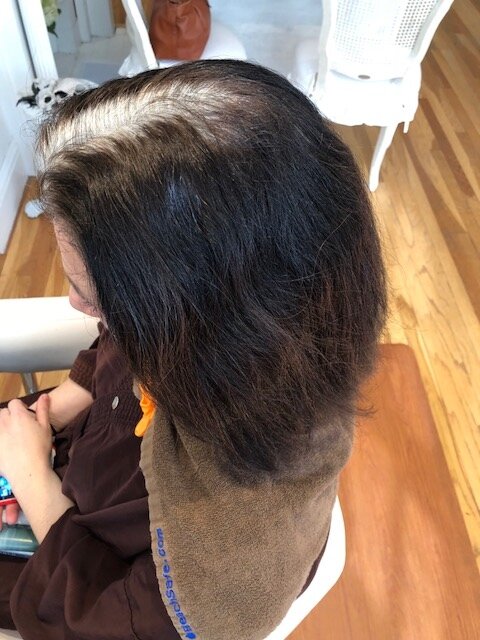
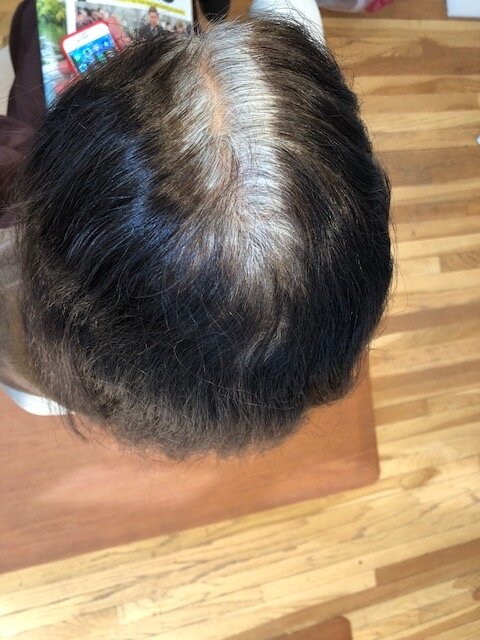
This week I had a client come to the salon. She was 39 years old and about 85-90% grey. The first thing I noticed wasn't the grey—it was the damage.
Her hair was far too dark for her skin tone, with visible bands of different brown shades stacked on top of each other from years of box dye applications. No transition, no dimension, just layers of progressively darker color trying to hide the grey that kept coming back stronger each time.
She told me her original goal was to stop coloring altogether and just "go natural."
I get it. Coloring your hair every 3-4 weeks is exhausting. It's expensive. It's time-consuming. And if you're fighting 80%+ grey coverage, it feels like you're on a hamster wheel that never stops.
But here's the hard truth I had to share with her: going fully white at 39 would age her by 20 years overnight. So even though it seemed like an option, it really wasn't.
The Grey Coverage Trap
Most women with significant grey fall into the same cycle:
They start with a natural-looking color. Then the greys come back. So they go darker to get better coverage. Then darker still. Until they're wearing a shade that's completely wrong for their skin tone and makes them look older than the grey ever did.
The bands of color my client had? That's what happens when you're constantly chasing grey coverage without a real strategy.
What Actually Works for Grey Blending
My long-term plan for this client was to gradually shift her base color to a dark blonde with heavy golden blonde highlights—as light as possible while still giving coverage. Dark blonde isn't white, but with less contrast, the grey becomes far less noticeable as it grows in.
For her first appointment, I:
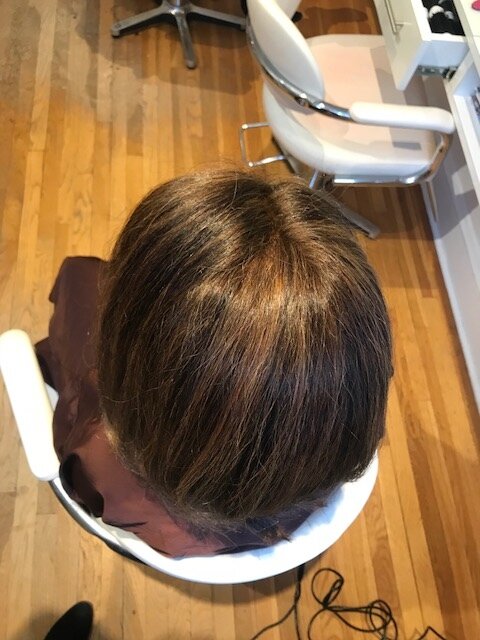
Changed her single-process color from dark brown-black to a light brown (three shades lighter)
Heavily highlighted the ends, especially around her face and on top, placing as much dark hair as possible into foils to break up that inky darkness
After processing, I applied a gentle product to chelate and loosen more dark color that hadn't been lightened in the foils—it lifted several levels and washed away during her shampoo
Finished with a caramel brown glaze combined with Olaplex to condition, even out, and add shine. This made the highlights melt naturally into her base color.
The result? A beautiful, softer, dimensional brown that actually complemented her skin tone.
I always want to complete the entire correction in one appointment, but hair has limits. I was thrilled with what we accomplished in one visit—and so was she.
But Here's What I Learned After 24 Years Behind the Chair
All of this work—the highlighting, the toning, the corrective color—only addresses the hair shaft. It makes grey coverage easier and creates better dimension, but it doesn't solve the underlying problem.
The problem is what's happening at your scalp.
When I moved to Arizona and my own hair started struggling, I realized something I'd never fully understood during my salon years: most women aren't dealing with a "grey coverage" problem or a "color fading" problem.
They're dealing with a scalp health problem that makes their hair weak, slow-growing, and unable to hold color properly.
Think about it: if your scalp isn't healthy, your hair grows in weaker from the start. Weak hair doesn't hold color well. It fades faster. It breaks easier. It looks dull even right after a salon visit.
You're spending hundreds of dollars every few weeks trying to fix hair that's compromised from the moment it comes out of your head.
The Shift That Changed Everything
Once I understood that my scalp was the issue—not my products, not my technique, not even the Arizona hard water—I was able to completely change my approach.
I stopped focusing only on what I was putting ON my hair and started addressing what was happening UNDER it.
And for the first time in years, my hair actually started growing longer, holding color better, and looking healthy between salon visits.
One of the products that became part of that newer approach for me was Rejuveniqe Oil. I use it on my own color-treated hair and as part of my scalp routine, especially when my hair is feeling dry from highlighting, styling, or the Arizona climate.
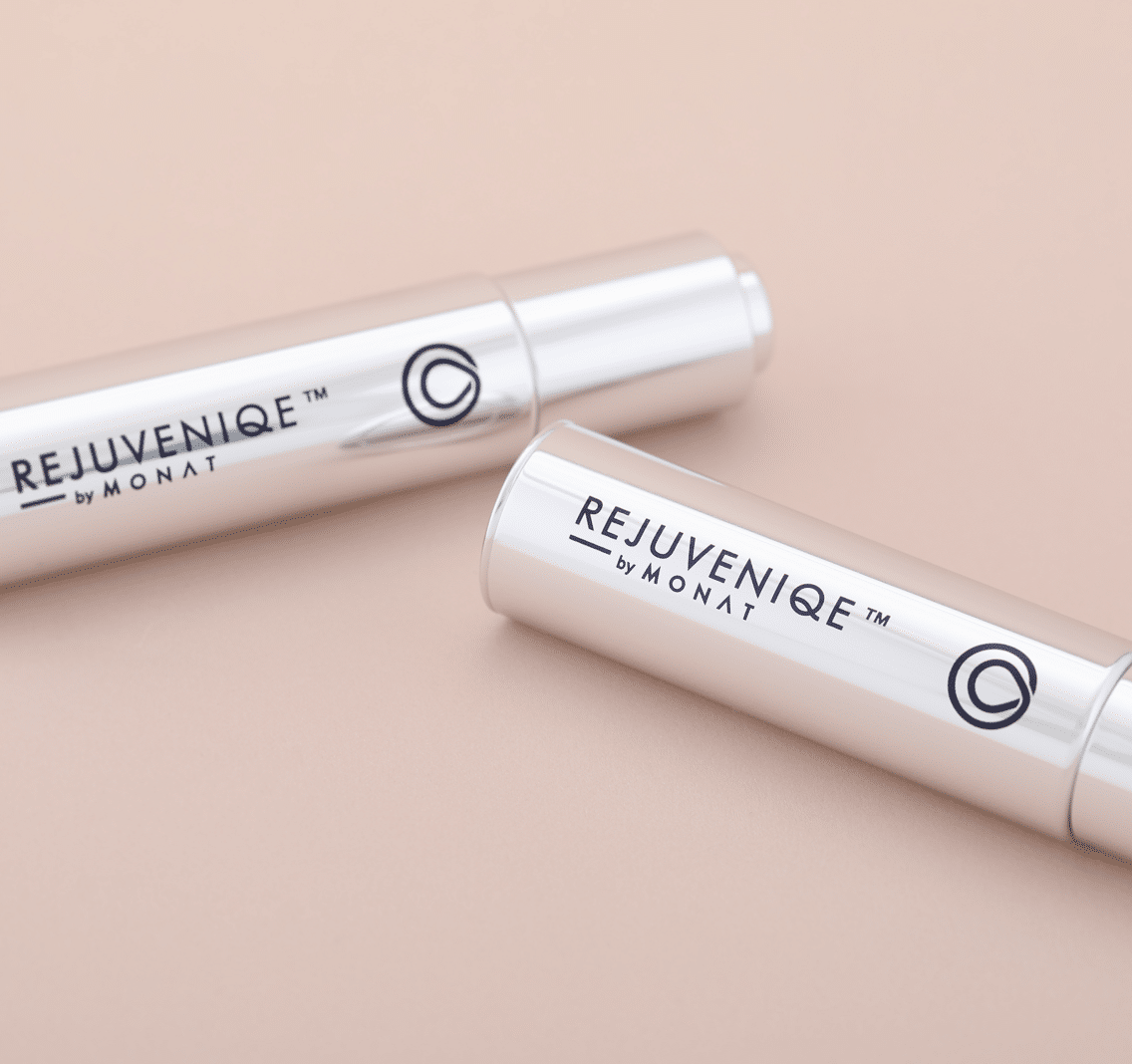
ONE OF MY COLOR-TREATED HAIR PICKS
The oil I use on my own hair
Rejuveniqe is one of the products I keep reaching for on my own blonde, color-treated hair when my scalp, lengths, or ends need extra conditioning.
Shop Rejuveniqe OilYou'll be taken to MONAT's secure retail checkout with Rejuveniqe already in your cart.
As an independent MONAT Market Partner, I may earn a commission on purchases made through my links.

ABOUT MEGAN GRAHAM
Megan Graham
Megan is a two-time Best of Boston award-winning colorist with 24 years behind the chair and former owner of Megan Graham Beauty on Newbury Street.
LEGAL DISCLAIMER: This blog post contains my personal opinions and experiences as a professional hairstylist. I am currently a MONAT Market Partner and may earn commission from product sales. The information provided is for educational purposes only and should not replace professional hair care advice. Individual results may vary. Always consult with a licensed professional for significant hair changes.