The Shocking Truth About "Premium" Dog Food (And What I Feed My Dogs Instead)
One of the most common questions I get on my YouTube channel is: "What kind of dog food do you feed your dogs?"
But here's the thing—it's not just about what I feed them. It's about why.
Anyone can tell you a brand name. But understanding why certain foods support your dog's health (and why others sabotage it) is what actually empowers you to make the best choice for your pet.
So I'm writing this blog to give you the full story—the research, the mistakes I made, and what I finally discovered that changed everything for my dogs' health.
Let me start with the wake-up call that sent me down this rabbit hole...
I'll never forget the day my vet called with Lola's bloodwork results.
Pancreatitis.

The best food grade dog food
My sweet senior Yorkie—the one I'd been feeding what I thought was the best dog food money could buy—was sick. And the worst part? I'd done this to her. Not intentionally, of course. But I'd fallen for the green-washed marketing of "premium" kibble brands that promise the world and deliver... well, we'll get to that.
If you're reading this, you probably care deeply about what goes into your dog's body. You read labels. You avoid the grocery store brands. You spend the extra money on kibble that claims to be "grain-free" or "ancestral" or "biologically appropriate."
I did all of that too.
And I still ended up with a sick dog.
What "Premium" Dog Food Companies Don't Tell You
Here's something most dog owners don't know (and the pet food industry definitely doesn't want you to know):
Most dog food—even the expensive "premium" brands—is feed grade, not human grade.
What's the difference? It's bigger than you think.
Feed Grade vs. Human Grade: The Reality
Feed grade means the ingredients don't have to meet human food safety standards. Pet food is regulated as animal feed—not food—which means manufacturers can use ingredients that would never be approved for human consumption.
This includes what's known in the industry as "4D meat"—animals that are Dead, Diseased, Dying, or Disabled.
Let me be blunt: That animal that died on the farm before slaughter? It can legally end up in your dog's bowl. Roadkill? Same. Animals euthanized at shelters? Also possible (along with their flea collars and ID tags).
These animals aren't slaughtered—they're collected by rendering plants that process waste animal tissue into pet food ingredients. And those ingredients show up on labels as:
Meat meal
Meat and bone meal
Animal by-products
Animal digest
Poultry by-product meal
The rendering process involves grinding and cooking these materials at high temperatures to remove moisture and fat. The result? Ingredients that are shelf-stable, cheap, and technically "safe" according to FDA standards—but are they what you want feeding your dog?
The Greenwashing Problem
The FDA has completely different standards for pet food versus human food, and the pet food industry has been operating in this gray area for decades.
Companies spend millions on marketing to make you feel like you're giving your dog restaurant-quality meals. Beautiful packaging. Phrases like "wholesome," "natural," "premium," and "ancestral." Images of fresh meat and vegetables.
But here's the truth: Claims don't equal quality.
Pet food companies aren't required to disclose their ingredient sourcing. They can say their food is "the highest quality" without proving it. They can show a picture of a steak on the bag while the actual ingredients are rendered meal from unknown sources.
This is what Susan Thixton calls "romance copy" in her book The Truth About Pet Food—marketing designed to seduce you emotionally while obscuring what's really in the bag.
My Wake-Up Call: When "Premium" Isn't What It Seems
I thought I was doing everything right. I was feeding Lola one of those brands that markets itself as premium, ancestral, protein-rich. The packaging is beautiful. The marketing is convincing. The price tag is high enough to make you feel like you're giving your dog the best.
But after Lola's pancreatitis diagnosis, I started diving deep into functional veterinary medicine and nutrition. That's when I discovered Susan Thixton's book and blog, "The Truth About Pet Food."
Reading that book was my aha moment. Everything clicked.
I realized I'd been completely greenwashed. Companies can say their food is "the highest quality" and make all kinds of claims, but that doesn't necessarily mean it's true. The marketing was slick. The ingredient list looked impressive. But when you actually understand what goes into pet food and how it's regulated (or rather, how it's not regulated), the truth is shocking.
Susan is a pet food safety advocate who does independent research and testing on pet food brands. She doesn't take advertising money. She just tells the truth about what's really in these bags and cans.
And what I learned changed everything.
Here's what I always tell people: Don't just take my word for it. Get the book. Do your own research. I've spent years diving into this, but you deserve to understand what you're feeding your dog and why it matters. Knowledge is power—especially when it comes to your dog's health.
What I Discovered: The Evermore Difference
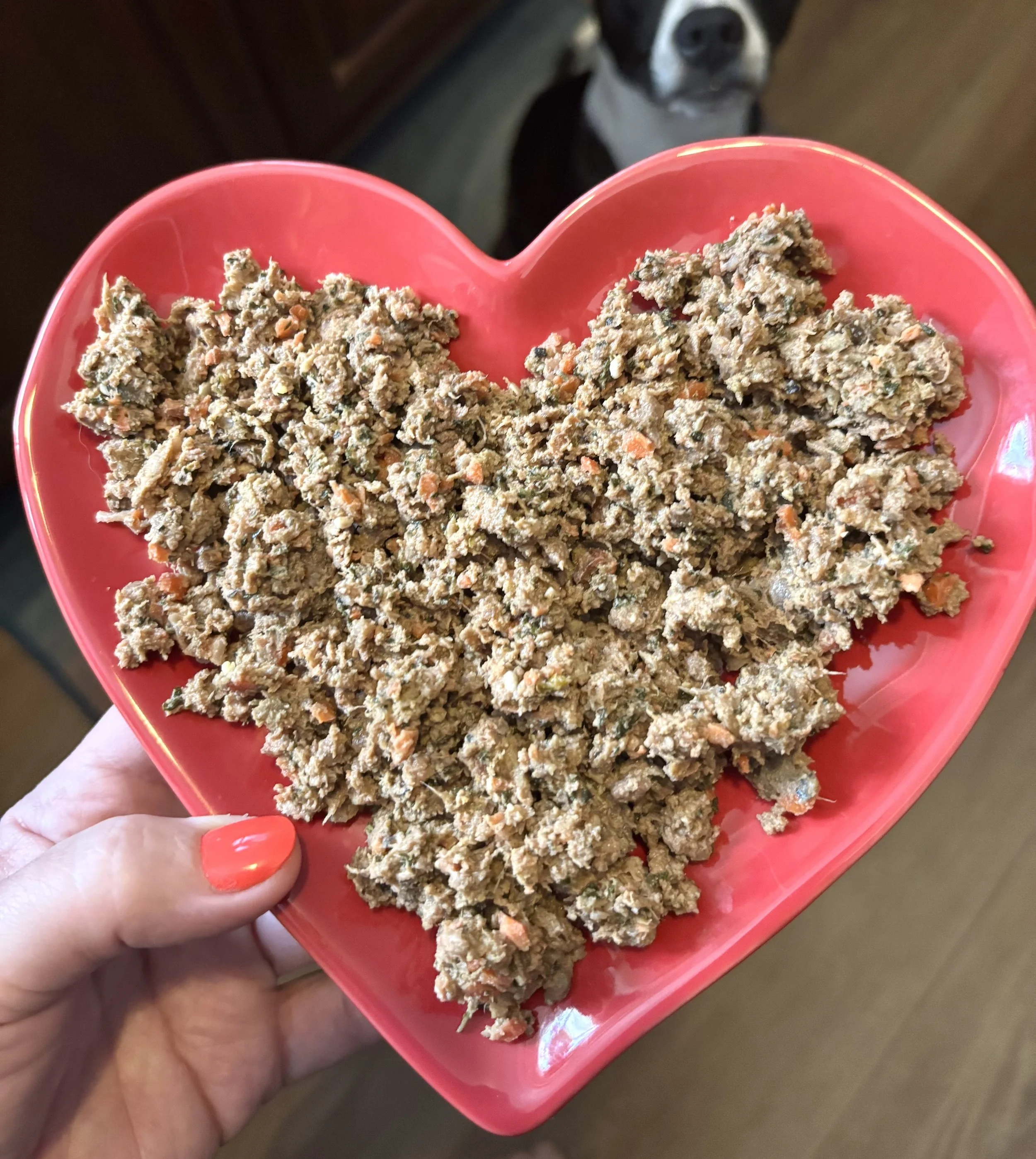
Evermore
My favorite high quality dog food
Through Susan's research, I found Evermore Pet Food—and I've been feeding it to my dogs for years now.
But before I get to Evermore, let me tell you about my failed DIY attempt. Because this matters.
My Home-Cooked Food Experiment (And Why It Failed)
After Lola's pancreatitis diagnosis and reading Susan's book, I was determined to take control. I started making home-cooked food for my dogs myself.
I researched recipes. I calculated portions. I bought quality ingredients. And for a while, I thought I had it figured out.
Then my dog Teddy's health started declining.
Turns out, I couldn't properly balance his minerals. Despite my best efforts, his diet became nutritionally unbalanced, and it showed in his health. Creating truly complete and balanced dog food at home is incredibly difficult—you need to nail the ratios of calcium, phosphorus, vitamins, and minerals, and even small miscalculations can cause problems.
This is why Evermore became my solution: It's essentially home-cooked food, but properly balanced by professionals.
They ship it frozen-fresh. I reheat it, fluff it up with a fork, and serve. My dogs get everything they need without the ingredients they don't need—and without me having to become a canine nutritionist.
Why Pancreatitis Happens (And Why Kibble Made It Worse)
Let me explain what I learned about pancreatitis, because this changed how I think about dog food entirely.
Pancreatitis occurs when the pancreas becomes inflamed. The pancreas produces digestive enzymes to break down food—especially fats. When you feed a high-fat meal, the pancreas has to work overtime to produce enough enzymes.
But here's what most people don't realize: It's not just about fat. Carbohydrates play a massive role.
Dr. Peter Dobias, an integrative veterinarian with over 30 years of experience, explains it perfectly in his article on pancreatitis:
"Processed food is one of the biggest causes of pancreatitis. Grain based, imbalanced, cheap food is the most common culprit, however, do not be mistaken. Even the so-called natural high-quality kibble is hard on the pancreas."
He goes on to explain that dogs evolved eating meat and some plant material—not large quantities of grain like wheat, corn, or rice. When you feed a carbohydrate-heavy diet, the pancreas has to produce excess insulin to manage blood sugar. This creates chronic stress on the organ, leading to inflammation.
Here's the problem with kibble:
High-carbohydrate content - Most kibble (even "premium" brands) is 30-60% carbohydrates because it's cheaper than protein and necessary for the kibble-making process.
High-fat content - Many "premium" kibbles are surprisingly high in fat (20-30%+), which puts constant strain on the pancreas.
Over-processing - Kibble is cooked at extremely high temperatures (often 300°F+), which destroys nutrients and creates compounds that are harder to digest.
Oxidized fats - The fats in kibble can become rancid during storage, creating inflammatory compounds that further stress the pancreas.
Mystery ingredients - When you're feeding rendered meals and by-products, you don't actually know what quality of fat your dog is getting.
For a dog with a sensitive pancreas (or any dog, really), this is a perfect storm.
Lola's pancreatitis wasn't random. It was the result of feeding her food that her body couldn't handle, even though the bag promised it was "premium."
Here's Why Evermore Is Completely Different
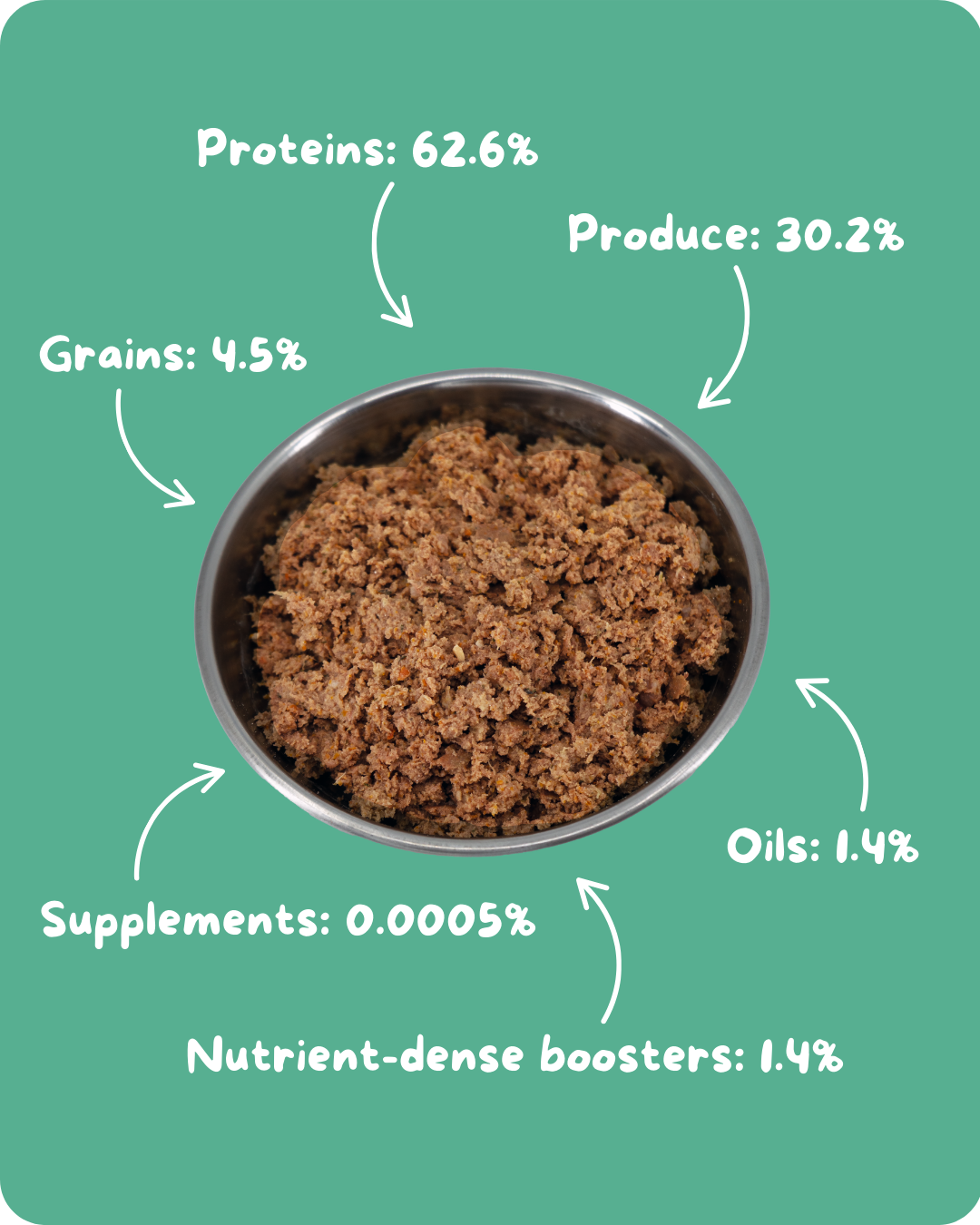
balanced nutrition
the Evermore difference
After years of use, here's what makes Evermore stand out from every other dog food on the market:
1. True Human-Grade Ingredients
Evermore isn't just marketing speak—their food is made in a USDA-inspected facility that also produces food for human consumption. Everything that goes into their recipes could legally be served to you at a restaurant.
100% grass-fed beef and lamb
Pasture-raised, antibiotic-free chicken and turkey
Organic vegetables (not GMO, not sprayed with pesticides)
No meat meals, by-products, or mystery ingredients
2. Gently Cooked Using Sous Vide (Why This Matters More Than You Think)
One of the founders is a classically trained chef, and she brought professional cooking techniques to dog food. The food is cooked sous vide—sealed in a bag and cooked in water to a precise temperature.
Why does this matter?
Because it's the Goldilocks of dog food processing: not too processed, not too raw, just right.
Compared to kibble:
Kibble is cooked at 300°F+ (often higher), which destroys heat-sensitive nutrients like vitamins B and C, antioxidants, and beneficial enzymes
The high heat also creates AGEs (advanced glycation end products) and acrylamides—compounds linked to inflammation
Sous vide cooking preserves up to 90% of nutrients because it never exceeds the precise temperature needed for safety
Compared to raw feeding:
Raw food can carry bacterial risks (E. coli, Salmonella) that are especially dangerous for immune-compromised dogs
For dogs recovering from illness or with sensitive systems (like Lola with GME), raw can be too risky
Gently cooked food eliminates pathogens while keeping the food as close to raw as safely possible
The result? Food that's digestible, nutrient-dense, and safe—without the risks of either extreme.
3. Transparency You Can Actually Verify
Evermore provides:
Certificates of analysis for every batch
Direct relationships with farmers and ranchers
Full traceability on every ingredient
Lab testing for E. coli, salmonella, listeria, and mold
They even ate their own food for a month to prove it's truly human-grade. (I love that.)
4. Minimal Supplementation Needed
Because Evermore uses such a wide array of whole-food ingredients, they don't need to add synthetic vitamins and minerals to make up for nutrient deficiencies. The food is naturally complete and balanced.
How to Spot Greenwashing in Dog Food (Educate Yourself)
I don't expect you to just take my word for any of this. That's why I always recommend Susan Thixton's book, The Truth About Pet Food. It's the resource that opened my eyes, and it will help you evaluate any dog food critically.
But here are some quick red flags to watch for on labels:
🚩 Vague protein sources:
"Meat meal" (what kind of meat?)
"Animal by-products" (from what animal?)
"Poultry meal" (chicken? turkey? something else?)
If they're not naming the specific animal, there's usually a reason.
🚩 Marketing words without meaning:
"Premium" - not regulated, means nothing
"Wholesome" - not regulated, means nothing
"Natural" - extremely loosely defined by AAFCO
"Made with real chicken" - could mean 3% chicken, 97% other stuff
🚩 "Made with human-grade ingredients" ≠ Human-grade food:
This is a sneaky one. A company can use human-grade ingredients but then process them in a feed-grade facility, which means the FINAL product is feed grade. True human-grade food must be stored, handled, processed, and transported according to human food laws at EVERY step.
✅ What to look for instead:
Named protein sources (chicken, beef, lamb - not "meat")
Minimal ingredient lists you can actually understand
Transparency about sourcing
Third-party testing (not just AAFCO minimums)
USDA facility certifications for human food
Companies that will answer your questions about sourcing
The pet food industry counts on you not asking questions. Ask them anyway.
Lola's transformation:
Zero pancreatitis attacks since switching to Evermore (it's been years)
Noticeably better coat—shinier, softer, healthier
She even tolerates the lamb recipe, which is huge for a dog with a sensitive system
Alfie (my picky Yorkie):
This dog is so picky that I sometimes have to hand-feed him
He devours Evermore—every last morsel
No more mealtime battles
All of my dogs thrive on this food. And that's the difference between feed-grade marketing and human-grade quality.
Click here to try Evermore - evermore-pet-food.sjv.io/aO2Pzo
10% off with my code MEGANGRAHAM
"But Isn't Fresh Dog Food Expensive?"
Let's talk about cost, because I know that's the elephant in the room.
Yes, Evermore is more expensive than kibble. But here's what I realized:
Kibble is cheap because the ingredients are cheap.
You're paying for rendered meat meals, synthetic vitamins, fillers, and ingredients that wouldn't pass human food safety standards. When you factor in vet bills from diet-related health issues (like Lola's pancreatitis), the "savings" disappear fast.
With Evermore, I'm investing in:
Fewer vet visits
Better long-term health
Peace of mind knowing exactly what my dogs are eating
Is Evermore Right for Your Dog?
Evermore is perfect if your dog:
Has a sensitive stomach or food allergies
Has been diagnosed with pancreatitis
Is a picky eater (seriously, even the fussiest dogs love this)
Is immune-compromised or dealing with health challenges
Is a senior who needs easily digestible nutrition
Or if you just want to feed the highest quality food possible
They offer four recipes: Beef, Chicken, Turkey, and Lamb. The Chicken and Beef contain organic oats and barley, while Turkey and Lamb are grain-free.
Pro tip: Start with their Quad Sampler so your dog can try all four flavors before you commit to a larger order.
The Bottom Line
After years of feeding Evermore, I can tell you this with absolute certainty:
This is the only dog food I trust.
I've done the research. I've seen the results in my own dogs. And I've watched Lola go from pancreatitis patient to thriving senior dog who still acts like a puppy.
If you've been on the fence about switching to fresh, human-grade food, this is your sign.
Your dog deserves better than feed-grade kibble dressed up in pretty packaging.
CLICK HERE TO BUY EVERMORE
10% off using my referral link and code MEGANGRAHAM
Frequently Asked Questions
Q: How long does Evermore last in the freezer?
A: The food arrives frozen and can be stored in your freezer for up to 6 months. I thaw what I need in the fridge for 24 hours before serving.
.Q: Can I mix Evermore with kibble?
A: Yes! Evermore works great as a topper or mixed with other foods. Many people start by mixing it with their current food and gradually transition to 100% Evermore.
Q: Is it really human-grade?
A: Yes. It's made in a USDA-inspected facility that produces human food. The founders literally ate it themselves to prove it.
Q: What if my dog doesn't like it?
A: In my experience (and from what I've heard from others), even the pickiest dogs love Evermore. But if you're worried, start with the Quad Sampler to test all four proteins.
Ready to Make the Switch?
Stop gambling with your dog's health. Stop trusting marketing over ingredients. And stop feeding your dog food you wouldn't eat yourself.
CLICK HERE TO LEARN MORE ABOUT
Your dog will thank you. (Probably by devouring their bowl and looking at you like you're the best human ever.)

Megan Graham
Megan Graham is a lifelong competitive athlete and two-time "Best of Boston" award-winning hairstylist with 24 years in the professional beauty industry. After building a successful career in Boston, her world shifted when she developed sensitivities to the fragrances and chemicals she'd worked with for years. At first, it felt devastating. Beauty was her career, her passion - and suddenly she couldn't use most products she loved. But instead of giving up, she made it her mission to find clean alternatives that actually worked. What she discovered surprised her: not only could she find effective low-tox products, many performed better than their conventional counterparts. But it took years of testing and significant investment to separate what truly works from what's just marketed well. Today, Megan shares those discoveries and brings new wellness modalities into the spotlight - helping others discover solutions they might never have known existed. For her, it's what makes everything feel like it happened for a reason: turning her own health challenges into a way to genuinely help others feel beautiful without compromise. When she recommends a product, it's with her whole heart.
Full disclosure: I'm an affiliate for Evermore, which means if you order using my link, I receive a referral discount on my next order. I only recommend products I genuinely use and believe in—and I've been feeding Evermore to my dogs for years. This post contains my honest experience and opinion.